
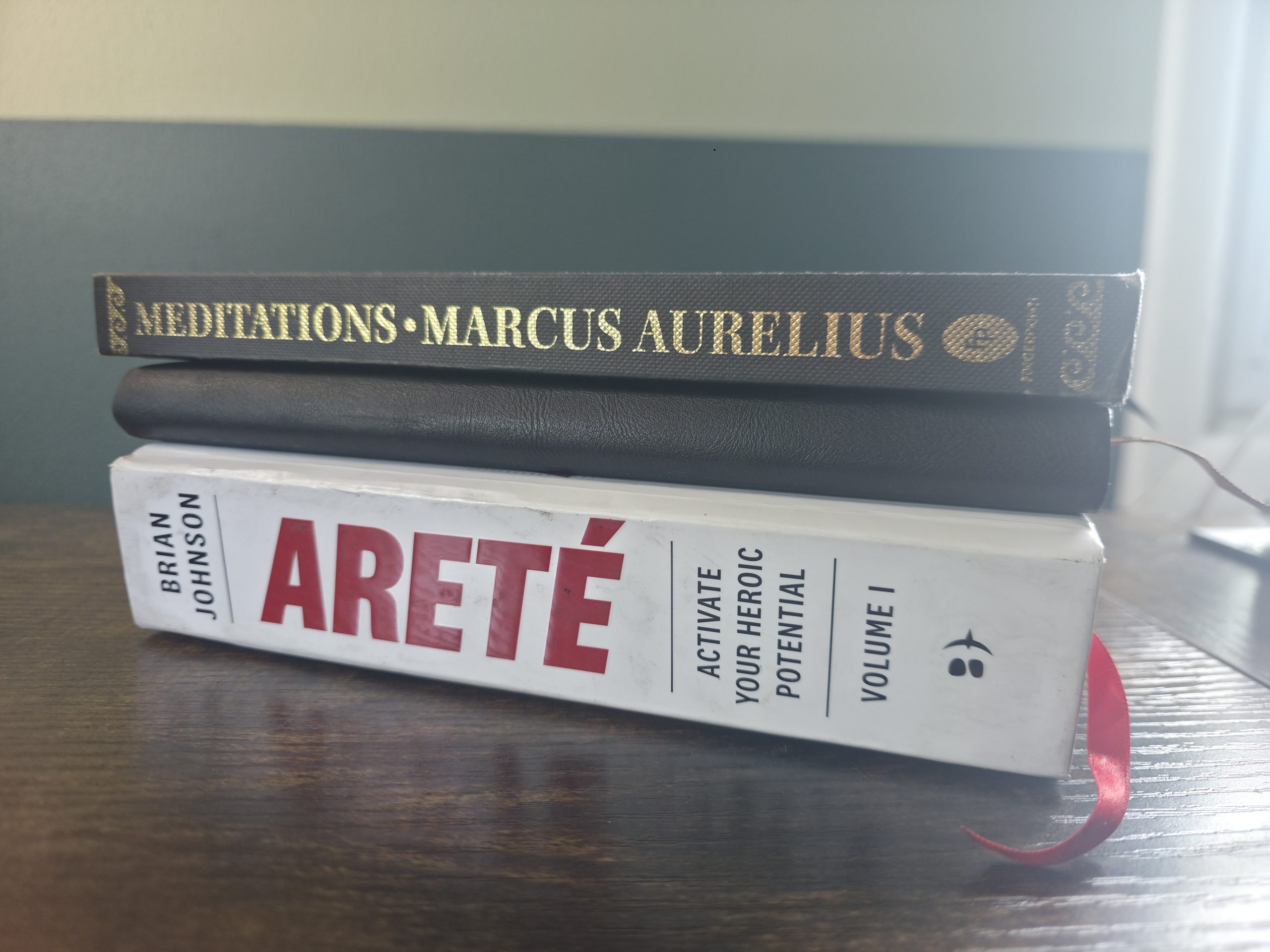
When most people hear the word stoic, they picture a guy who feels nothing. Jaw set, no reaction, taking whatever comes without letting it move him. The strong silent type who buried everything so deep it stopped showing. That is what the word has come to mean in plain English, and it is close to the opposite of what the actual philosophy teaches. The lowercase version is about feeling nothing. The capital-S version is about something a lot more useful, and a lot more human.
That picture has a long life in ordinary English, and it got there honestly. The word grew out of a real school of philosophy and then drifted a long way from what those writers were actually training. A philosophy that talks about endurance and self-command is easy to flatten into “feel less,” and feel less is easy to admire from a distance. Nobody set out to lose the meaning. It wore down the way words do, until the word stoic kept the face and dropped the training.
What They Were Training
The name comes from a porch. Zeno taught at the Stoa Poikile, the painted colonnade at the edge of the Athenian marketplace, and the school took its name from that building. For a long stretch the word just meant the people who met there and worked on these questions. It picked up the meaning of a facial expression much later.
Capital-S Stoicism is a practice for living. Marcus Aurelius, Epictetus, and Seneca were working a small set of questions: what is up to you, what is not, and how you meet the part that is yours. Epictetus put the dichotomy of control at the center of that work. Some things belong to your judgments, your actions, and your responses. Events, other people, and outcomes do not. Peace comes from putting effort where it can land and releasing the rest. That lens already has its own piece here, so I will not rebuild it. The point for this distinction is simpler. The philosophy trains how you answer what happens.
Seneca went after anger hard, and he meant cutting it out rather than managing it. That is the part the friendly modern version skips. What he was cutting was the judgment underneath the anger. The jolt he left alone, because nobody gets a vote on the jolt. You go pale. Your stomach drops. You flinch before you have decided anything. What comes after that is yours: what you decide the thing means, and what you do about it. The stereotype is numbness. The practice is clarity.
Nobody Is Born Stoic
You do not wake up stoic the way you wake up tall. It is trained, daily, the same way any other discipline is trained. Some days the training holds. Some days it slips. Nobody masters it permanently and then clocks out. That is why it fits the rest of the work on this site. The practice is the point. Kept promises, small and repeated. The Hard Path has the same shape. You show up and take the next honest response, and you do it again tomorrow.
People treat the word like a personality test. You either have it or you do not. That gives one guy an excuse and tells the next guy the door is closed. Both readings are wrong. The wiring you were born with does not settle anything. The work you do when your turn comes settles it.
Brian Johnson teaches this as being a warrior of the mind instead of a librarian of the mind. The librarian catalogs the ideas and keeps them in order. The warrior takes them into the arena and uses them. That is the part the everyday word dropped.
Acceptance Is Work
“Accept what you cannot control” sounds like quitting. People hear it and picture a guy who stopped trying. What it actually does is free up the effort you were burning on things that were never yours to carry. That effort goes into the part you can move. It looks quiet from the outside and it is work the whole time.
The same mistake is where people get the idea that these men were cold. The Stoics cared. Deeply. Family, duty, friendship, the quality of a life. What they refused was letting the caring run them. The practice holds both at once.
They had names for the feelings worth having. Joy that comes from living well instead of from things going your way. Goodwill toward the people in your life. A clear-eyed caution that keeps you out of trouble without turning into dread. That list answers the stereotype on its own. You do not keep a word for joy if the goal is to feel nothing.
Why the Mix-Up Costs Something
The bottled-up version is a bad tool. Calling suppression strength is a reliable way to get brittle. People hear that version, reject it, and walk away from a practice that would have helped them meet a hard week without either exploding or going numb. That is the cost of the wrong word.
The useful version is plainer. Feel what is there. Look at what is yours to do. Respond on purpose. That is why the philosophy has been a practical tool for me, a way of answering instead of reacting.
Everyday English is not going to wait for a correction. People will keep using “stoic” for the guy who shows nothing. Fine. The real thing is still sitting underneath the misuse, more human than the stereotype and more useful. Anyone willing to practice it can pick it up. The training is the whole of it.