
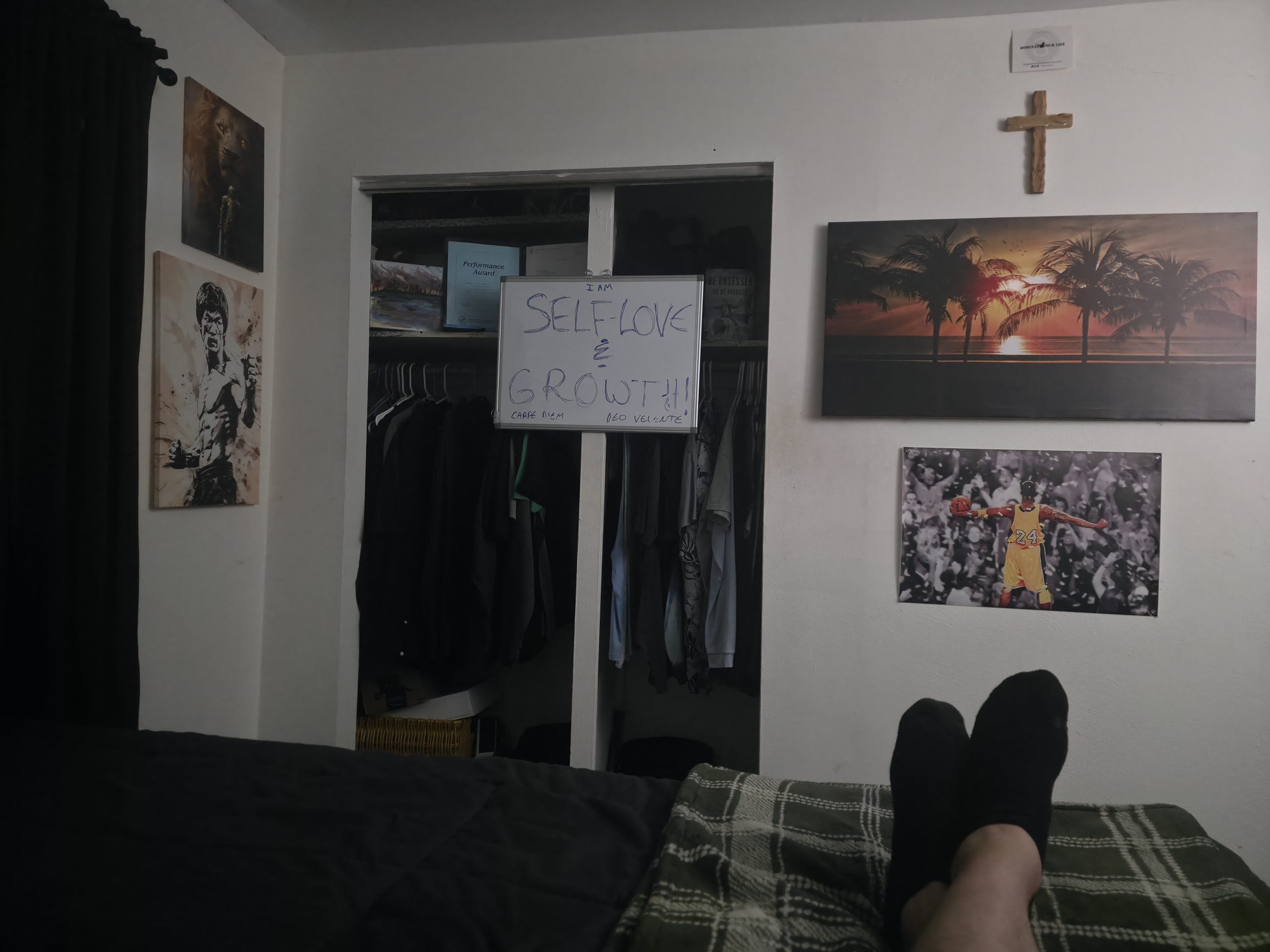
Blacked-out windows. Cross above the closet. Self Love & Growth on a whiteboard I wrote myself. The morning light isn’t here, but the wall is — Bruce Lee, Kobe, the Thailand print, the small box that says dominate your life. I sit on the bed in the half-dark and do the gratitude work first. By the time I open my eyes there’s a quiet in the chest that wasn’t there when I sat down. I didn’t earn it from anything outside this room. The room and the work made it.
This specific quiet has a name. The Stoics called it eudaimonia.
Most modern translations try to soften the word. They call it “happiness” or “flourishing,” but those words carry too much baggage. In our world, happiness is usually something you chase or something you buy. It’s an emotional high: a spike in the chart that eventually has to come back down.
Eudaimonia is the floor, not the spike. It is the physical sensation of a man whose actions have finally lined up with the person he is trying to become. It is the settled feeling in the bones that shows up when the gap between my potential and my reality closes by even a fraction of an inch. It doesn’t scream. It doesn’t require a crowd. It is a self-generating well-being that exists entirely within the four walls of my own discipline.
The Loud Versions
Most men chase a different kind of feeling. The Daily Drift is the state where external stimuli dictate the internal temperature.
The drift offers plenty of substitutes for real well-being. There is the dopamine hit of the scroll. There is the temporary numbness of the drink. There is the hollow validation of a social media “win” or the brief ego-inflation of a purchase you didn’t need. These feelings are loud. They are bright and immediate.
But they have no half-life.
The moment the screen goes dark or the glass is empty, the gap returns. The body knows the difference between a real meal and a sugar hit. The hit leaves you hungrier than you started.
Most personal development advice fails because it tries to give better sugar. It treats inspiration and passion as if they happen on their own. It treats growth like a mood to wait for. But eudaimonia is a consequence. The work has to happen first; the feeling shows up after.
The Calibration of the Kept Promise
The body is a precision instrument for truth. When I tell myself I’m going to get up at 5:00 AM and I actually do it, something happens in the nervous system. When I say I’m going to do twenty minutes of focused work and I don’t touch my phone, a kept promise lands in the chest.
Each small kept promise calibrates the system.
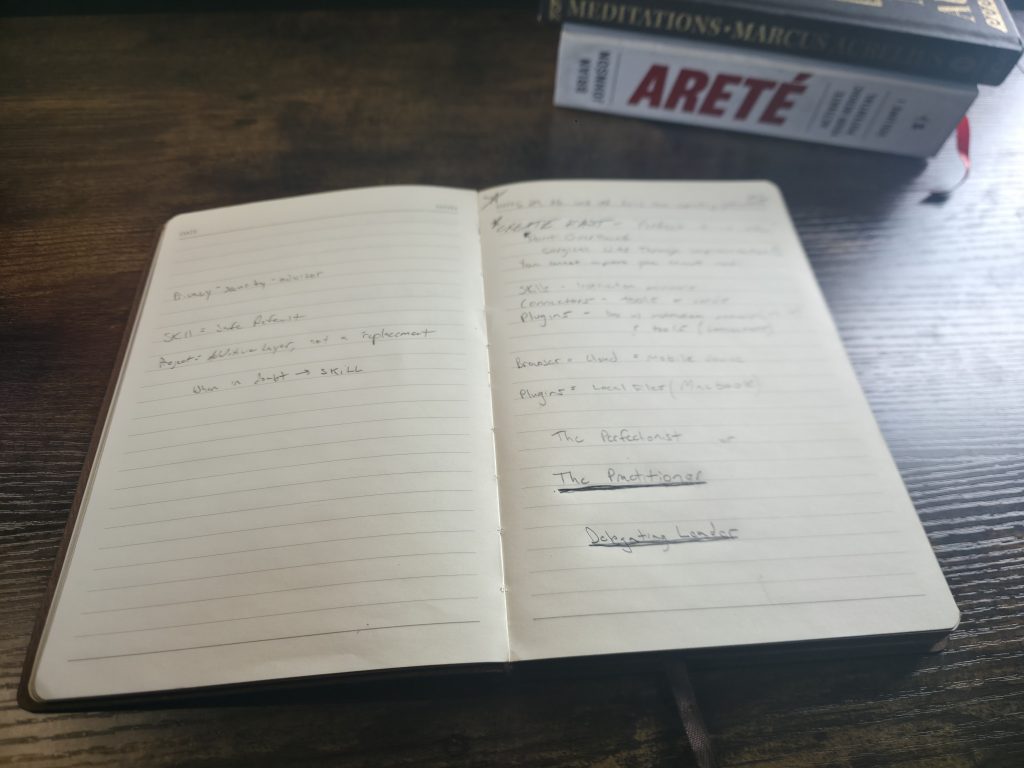
If I spend years breaking promises to myself, the internal compass stops working. I stop trusting my own word. I start looking for outside experts, hacks, and shortcuts that promise to do the work for me. I go looking for the next quick fix because I’ve lost faith in the incremental.
But when I commit to the Hard Path, I re-calibrate. The quiet feeling after a workout beats the frantic feeling of a three-hour YouTube binge. The satisfaction of a disciplined day has a “flavor” that the drift can’t replicate.
This isn’t willpower. It’s taste. Once a man has tasted the real thing — the heavy, solid reality of living on-purpose — the loud substitutes start to taste like ash. You don’t have to “fight” the urge to drift quite as hard because the drift no longer delivers what you’re looking for. The loud version stops working.
The Compound Effect of Alignment
In stoic philosophy, there is no final destination where the work is over. The goal is to stay in the state of alignment.
It becomes a cycle that feeds itself. The first kept promise produces a tiny sliver of eudaimonia. That sliver gives you just enough internal stability to make the next right decision. Each act of discipline makes the next one easier — not because the task gets lighter, but because the person doing the task is becoming more solid.
Eventually, the question changes. You stop asking, “How do I motivate myself to do the work?” Motivation is for people who are still trying to decide if the work is worth it.
Instead, you start asking, “What would I have to do to give this feeling up?”
To go back to the drift, I would have to start lying to myself again. I would have to ignore the quiet in my chest. I would have to trade my own ground for somebody else’s noise.
The cost of quitting becomes higher than the cost of the work.
Staying in the Room
The world will try to pull me out of the room. It will offer me a thousand ways to feel “good” without having to earn it. It will tell me that I’ve done enough, that I deserve a break, that the breakthrough I’m looking for is one click away.
The quiet is waiting in the work I said I’d do. It’s waiting in the gratitude practice I almost skipped and the difficult conversation I’ve been avoiding. It is the reward that cannot be taken from me because it was never given to me by anyone else.
The room and the work made it.