
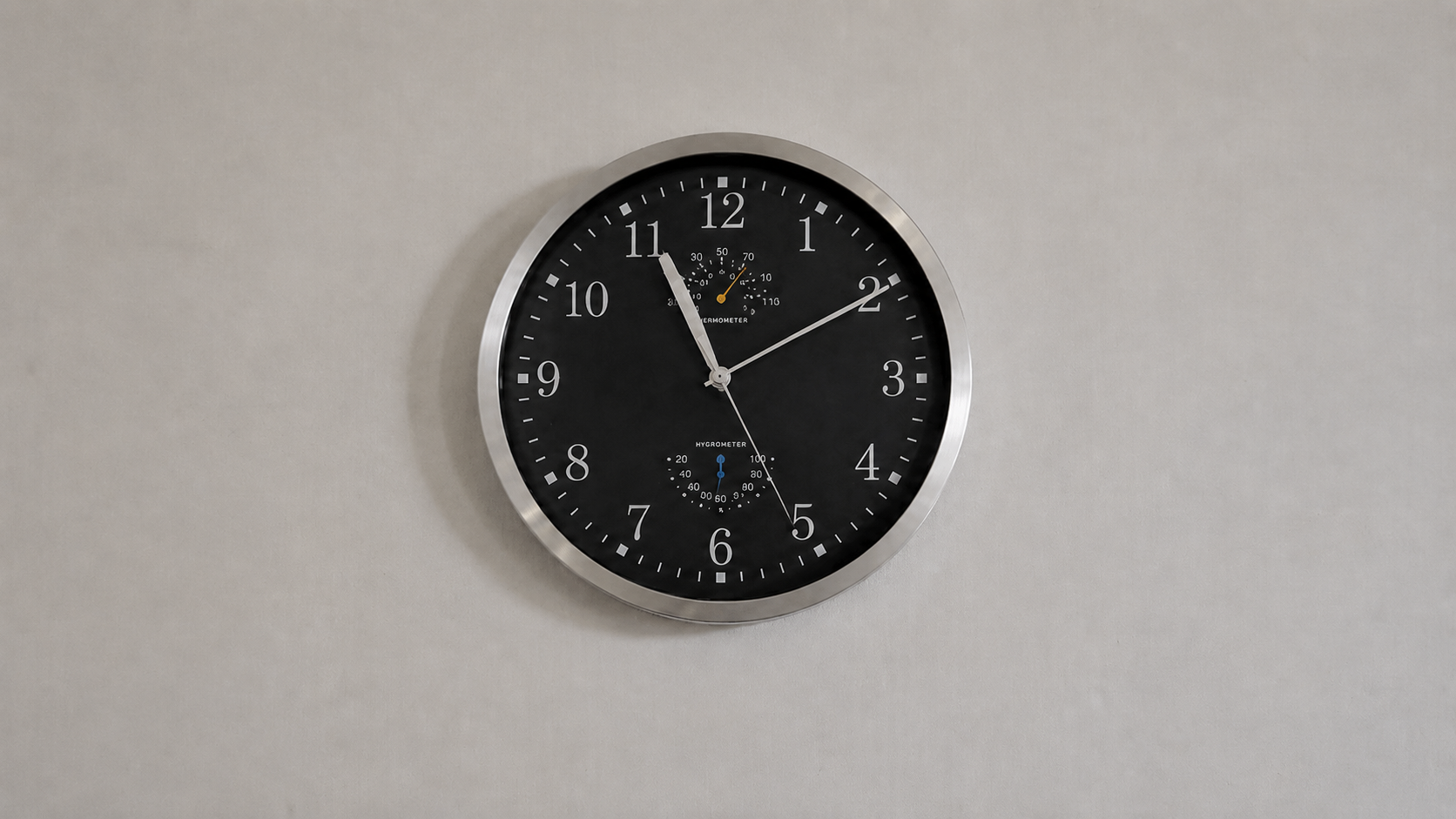
I lost twenty years once. Not to one bad day — to a long string of ordinary ones I told myself didn’t count, that I’d square up later. Later showed up. The twenty years didn’t. Now there’s a door open in front of me, real work I could actually start, and the only thing louder than the chance is the clock that already ate two decades.
That weight has a name. The Stoics called it memento mori — Latin for “remember you will die.”
In most circles, that phrase sounds morbid. It sounds like something you’d see on a tombstone or a heavy piece of monastic art. But the Stoics weren’t interested in being morbid. They were interested in being honest. They used the practice as a clarifying tool: not to produce fear, but to sharpen their focus.
The point isn’t that life is ending. The point is that time is real.
Most men live in a state of quiet denial. They drift through their hours as if they were free. They assume there is always more runway, more room to start over, and an infinite supply of Mondays. This is how the Daily Drift sustains itself. It relies on the unspoken lie that the clock isn’t actually running.
The Cost of the Hour
The drift is comfortable because it lets you forget the math. It’s a soft fog that settles over the calendar. When time feels infinite, the scroll is free.
I can sit on the couch and watch ninety minutes of other people’s highlights because I haven’t done the math on what it costs. I treat the hour like a rounding error. I tell myself I’ll get to the Hard Path once the weekend is over or once the energy is right. I’m spending currency I haven’t earned, assuming the bank account has no bottom.
But when memento mori lands in the chest, the math changes.
The hour isn’t a rounding error anymore. It’s a real, physical withdrawal from a finite well. It’s heavy. It has a specific weight that pulls at the ribs. Once I remember the clock is running — really remember it, in the bones — the drift’s substitutes start to taste like ash. The dopamine hit of the scroll doesn’t just cost attention; it costs a chunk of the only resource I can’t earn back.
The Stoics used this weight to stay upright. For them, death was a present reality, not a distant event to be feared — and it determined the value of the current second. Every hour spent in the drift is an hour effectively dead to a man’s own potential.
Calm Attention Over Frantic Motion
There is a popular misreading of mortality that produces a frantic, exhausting intensity: the idea that you have to squeeze every drop of pleasure out of the day because it might be the last one. It’s the “burn the candle at both ends” philosophy that leads straight back to burnout and distraction.
Stoicism doesn’t run on that fuel. The squeeze-every-drop urgency is just a different kind of drift.
The Stoic version of memento mori produces calm. It doesn’t make me want to jump out of a plane or spend my savings on a vacation. It doesn’t produce a heart rate of 140 while sitting at a desk. It produces attention.
It makes me want to sit down and do the work I said I’d do. It makes me want to have the difficult conversation I’ve been avoiding. It makes me want to look at the people in my life without the filter of my own distraction. It is the quiet realization that the kept promise I made to myself this morning matters more because the morning itself is limited.
The drift is what’s depressive. There is nothing heavier than watching weeks evaporate into a blur of “later.” There is nothing more draining than the vague feeling of being behind on a life you haven’t started living yet.
Memento mori restores the weight. It gives the day heft. It turns a Tuesday from a throwaway day into a day that counts against the total.
Marcus Aurelius put it plainly:
“You could leave life right now. Let that determine what you do and say and think.”
— Marcus Aurelius, Meditations 2.11 (Hays translation)
The Truth of the Runway
I used to think that remembering the end would make me anxious. I thought it would make the room feel small. I thought it would lead to a paralyzed state of “what’s the point?”

I was wrong.
The anxiety lives in the denial. The fear lives in the state where I’m pretending the runway is infinite while watching the miles disappear in the rearview mirror. It’s the debt of the unlived life that keeps me awake at night.
Clarity lives in the count.
When I accept that the Mondays are limited, I stop waiting for the perfect one to arrive. I stop behaving as if I am destined to live forever and start behaving like a man who has work to do. This is a state of No Drift — the decision to stay with the clock instead of running from it, not a productivity hack or a way to “get more done.”
Each act of discipline is a vote for the person I am becoming inside the time I have left. The work matters because the time is real. The promise matters because I am the one keeping it.
The clock is running. The room is quiet. The work is waiting.
I am one of the finite men who was given today.